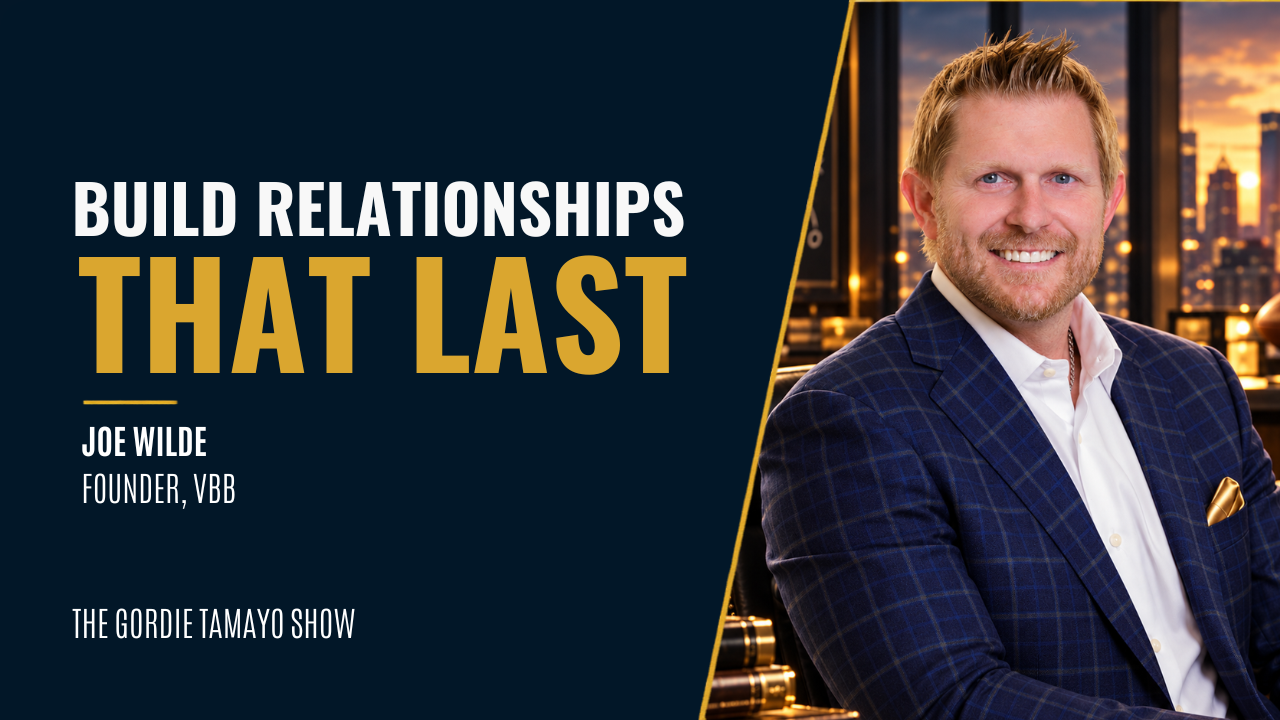
VBB founder Joe Wilde joins Gordie Tamayo to discuss the family values behind his approach to people, the experiences that shaped his listening, and why helping others succeed is central to his “Athletes of Business” vision.
Gordie Tamayo has watched Joe Wilde start conversations with everyone from flight attendants to mayors. What stands out is what happens after the introduction: Joe remembers the people, the details, and the connections that might matter later.
When Gordie points this out, Joe’s first thought is of his parents.
“As much as you were talking about me, you were really talking about my parents,” he says.
That response sets the direction for this episode of The Gordie Tamayo Show. For Joe, building genuine relationships begins with lessons learned long before a career: treat people well, ask questions, and take time to understand who is in front of you.
The Core Question
How do you build genuine relationships that create trust and opportunity in business and life?
Joe’s answer begins with curiosity about the person. Listen for what matters, leave room for honesty, and take the initiative to connect. When an opportunity follows, the relationship already has something deeper to support it.
About This Episode
In this episode of The Gordie Tamayo Show, Gordie Tamayo, Chief Digital Architect at Boise Beat, speaks with Joe Wilde, founder of VBB, about authentic networking, listening, self-confidence, and earning trust.
Joe shares personal stories about growing up in Toledo, his childhood vision difficulties, his connection to Notre Dame, and a chance introduction to Dwayne Ariola. The conversation also explores VBB’s “Athletes of Business” concept and the support that helps executives and professionals build visibility around their expertise.
Three themes shape the conversation:
- Identity opens the conversation. Family, hometowns, and shared interests can reveal what matters to someone.
- Trust requires openness. Setting ego aside, accepting rejection, and acknowledging mistakes make honest relationships possible.
- Opportunity grows through connection. An introduction can bring people together whose experience, skills, and needs complement one another.
PRESS PLAY — Watch or listen to the full Joe Wilde interview below.
Why Does Joe Wilde Ask “Where Are You From?”
Joe often begins a conversation with a question that has little to do with someone’s career: “Where are you from?”
For him, a hometown offers a path into identity. Toledo, Ohio, brings up family, upbringing, and the values that continue to guide his choices. Asking someone else about their roots gives that person room to share something similarly meaningful.
His curiosity has a purpose: understanding what matters to the person before making assumptions about them.
That distinction becomes clear when Gordie asks about building business relationships. Joe explains that he sees the relationship first. He wants to understand someone’s family, interests, and character alongside their work.
He demonstrates this with Gordie, mentioning his family, wrestling, and the effort he puts into helping others build their brands. The description reaches beyond a professional introduction to recognize the person doing the work.
*** PRESS PLAY ***
What Happens When Someone Really Pays Attention?
One of the most revealing moments happens when Joe notices Gordie’s reaction to being praised.
Instead of continuing with his own point, Joe asks about the response. Gordie acknowledges that receiving recognition can feel awkward and that insecurity may play a part.
The exchange offers a small example of the attention they are discussing. Joe notices a reaction, becomes curious about it, and asks a follow-up question.
He connects that openness with lessons he says he learned through his experiences at PwC and Bridgewater Associates. Effective collaboration, in his view, requires people to set ego aside and acknowledge what they do not know.
It also requires patience. Joe believes that helping someone should not depend on an immediate return. He describes approaching relationships without keeping a scorecard.
How Childhood Experiences Shaped Joe’s Listening
Joe is comfortable acknowledging that he talks a lot. Gordie is equally quick to point out how much he remembers.
When asked about that combination, Joe shares a difficult part of his childhood. He says he was blind until age five and wore an eye patch until age thirteen, enduring stares, teasing, and bullying.
Looking back, he believes those experiences influenced how closely he listened.
“I used my ears. I listened,” he says.
Joe presents this connection as his own reflection on his life. What he emphasizes is the importance of two-way communication: speaking, listening, asking questions, and being willing to admit uncertainty.
The childhood story also helps explain his attitude toward rejection. He expects some interactions to fall flat. His response is to learn from them and remain willing to try again.
Notre Dame, Shared Identity, and a Search for Tickets
Notre Dame is a recurring thread in Joe’s stories because its meaning extends beyond football. He calls the university his “North Star.”
He describes his mother’s connection to Notre Dame, a mentor associated with the university, and the values he attached to it as a young person. His own path led to Fordham University, where he played golf and met his future wife.
That background gives context to a memorable family trip to a Notre Dame national championship game, with no tickets in hand.
Joe recalls walking around a hotel wearing a sign asking for a ticket. Existing connections helped spread the word. According to his account, encounters with Regis Philbin and Rudy eventually helped the family secure tickets.
The story illustrates how personal history can create unexpected connections. It also shows Joe’s willingness to make an introduction possible. He put himself in a position where someone could start a conversation, recognize a shared connection, or offer help.
How Do You Handle Rejection Without Losing Confidence?
Gordie recalls watching one of Joe’s energetic introductions receive a less enthusiastic response. Joe accepted it and moved on.
Asked what someone quieter can learn from that, Joe focuses on self-acceptance. He discusses being able to respect the person he sees in the mirror while acknowledging that he will make mistakes as a father, spouse, and businessperson.
He also describes learning through observation, including watching people during his years in New York City and developing cultural awareness through his work.
There is no single script that makes every introduction work. His approach is to pay attention, learn how people respond, and accept that some conversations will not become connections.
The part he can control is how he responds.
How Joe Wilde Met Dwayne Ariola
Joe’s story about meeting Dwayne Ariola shows how quickly an ordinary moment can become an opportunity to connect.
During a dinner around INTERPHEX in 2026, Joe heard a woman at the table identify someone walking nearby as an important person at the conference whom many attendees might not recognize.
Joe got up, introduced himself, and invited the man to an after-hours gathering.
That man was Dwayne Ariola.
Joe describes their relationship developing through candid conversations, shared values, and an interest in helping people. The initial introduction led to learning more about each other and making further connections.
The story also places Joe’s relationship philosophy within his work. He describes VBB as operating at the intersection of talent, media, and network, with gatherings involving the Life Sciences Capital Forum, Digital Unicorn, and other collaborators creating space for people to meet.
An event brings people into the room. Someone still has to notice the connection and start the conversation.
How Do You Protect Trust When Business Plans Fall Short?
Relationships face a different test when an opportunity does not meet expectations.
Joe’s answer is direct: transparency and accountability.
He emphasizes acknowledging mistakes and asking what could have been done differently. An unsuccessful attempt can become a learning experience—and, when handled honestly, a chance to strengthen the relationship.
His preferred role comes through in a basketball analogy.
“I want to be John Stockton,” Joe says. “I’m just going to pass you the ball.”
The comparison captures his interest in making the assist. Helping someone else succeed can be a meaningful contribution, even when he is not the person receiving the most attention.
What Are VBB’s “Athletes of Business”?
VBB’s “Athletes of Business” concept applies the idea of representation and support to executives and professionals.
Joe introduces it with a question: if professional athletes have agents helping them manage opportunities, why shouldn’t executives have similar support?
He discusses name, image, and likeness as a way to consider the identity and reputation of the individual alongside the organization they represent. His emphasis is on the infrastructure that allows people to focus on their expertise while receiving help with visibility and opportunities.
During the conversation, Joe points to several people:
- Nathan Roman: Joe highlights Nathan’s professional identity around temperature mapping.
- Dwayne Ariola: Joe discusses Dwayne’s relationships and experience across multiple organizations.
- Tevon Coney: Joe connects Tevon’s football background with his transition into the corporate world.
- Tommy O’Donnell: Joe includes Tommy in the discussion of executives who can benefit from broader support.
Joe also names Gordie as an “Athlete of Business,” pointing to his production work and the platform and infrastructure behind Digital Unicorn.
The concept brings the interview’s themes into a business setting: recognize what someone contributes, connect that person with complementary people, and build support around their ability to perform.
Episode Highlights
- Why Joe credits his parents for his approach to relationships
- How “Where are you from?” opens a more personal conversation
- The moment Joe notices Gordie’s discomfort with recognition
- Joe’s reflections on childhood blindness, listening, and resilience
- The Notre Dame ticket story involving Regis Philbin and Rudy
- Learning from rejection while staying comfortable with yourself
- How a dinner conversation led Joe to introduce himself to Dwayne Ariola
- Why transparency matters when an opportunity falls short
- The John Stockton analogy for helping others succeed
- VBB’s “Athletes of Business” concept and the people discussed
Who Is Joe Wilde?
Joe Wilde is the founder of VBB. In this interview, he describes his work as connecting talent, media, and networks, and shares the relationship philosophy behind VBB’s “Athletes of Business” concept.
Originally from Toledo, Ohio, Joe attended Fordham University. His conversation with Gordie draws on family experiences, his connection to Notre Dame, and lessons from his professional life to explore how people build trust and create opportunities together.
Learn more at VBB’s website and watch the full conversation on The Gordie Tamayo Show.